The History of the Stoa of Attalos
The history of the Stoa of Attalos in Athens — donated by Attalos II of Pergamon around 150 BC, destroyed in AD 267, and rebuilt in the 1950s as the Ancient Agora museum.
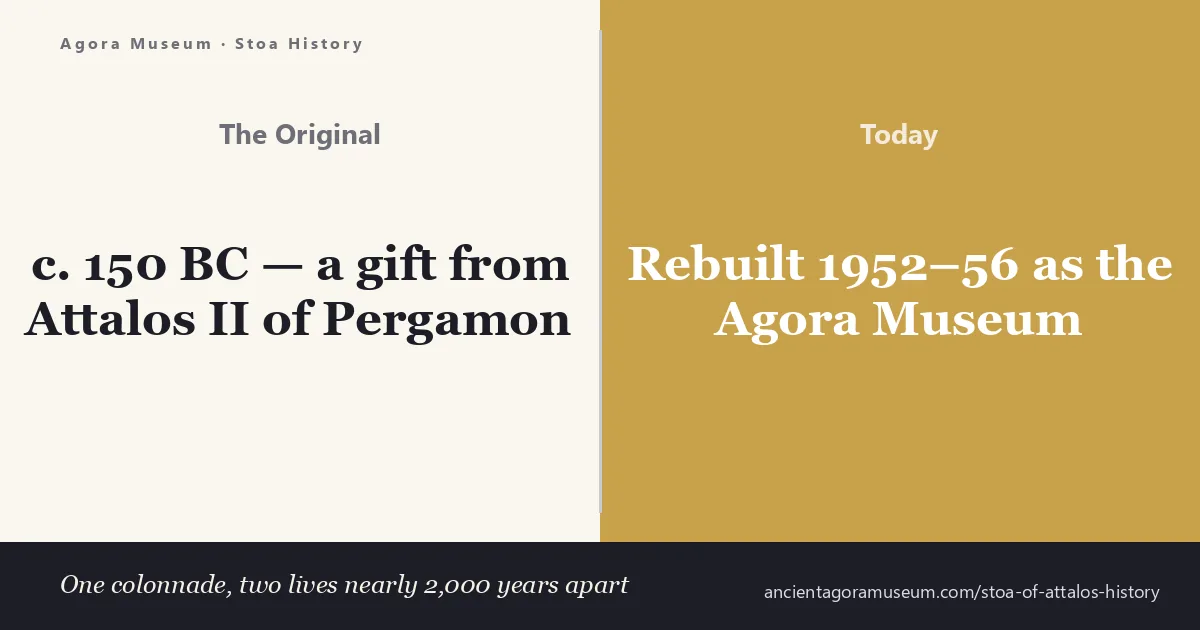
The Stoa of Attalos is the one building in the Ancient Agora you can walk through as a whole, not imagine from a footprint — and that’s because it has effectively lived two lives, nearly two thousand years apart. The first was a Hellenistic gift to Athens; the second, a mid-twentieth-century reconstruction so faithful it now houses the Museum of the Ancient Agora. Knowing the story turns a handsome colonnade into the most quietly remarkable structure on the site.
A Gift From a Grateful King (c. 150 BC)
The original stoa was paid for by King Attalos II of Pergamon, who ruled the wealthy Anatolian kingdom from 159 to 138 BC. As a young man he had studied philosophy in Athens, and the building was his thank-you to the city — a piece of royal diplomacy in marble as much as a public amenity. Built around 150 BC, it gave the eastern side of the Agora a grand, shaded place to meet, stroll, do business and shelter from the sun.
It was a serious building: two storeys, about 115 metres long and some 20 metres deep, with a double colonnade on each floor and a row of 21 shops along the back of each level — 42 in all. The materials were deliberately fine — white Pentelic and blue-grey Hymettian marble over limestone walls. For nearly three centuries it anchored the commercial life of the marketplace.
Destruction (AD 267)
That long life ended violently. In AD 267 a Germanic people called the Herulians sacked Athens, and the stoa was destroyed along with much of the lower city. Its ruins were later folded into a defensive wall, and for the better part of two millennia the great colonnade survived only as foundations and scattered blocks — much like everything else in the Agora.
A Second Life (1952–1956)
Here the story turns unusual. When the American School of Classical Studies at Athens (ASCSA) excavated the Agora in the twentieth century, they made a bold decision: rather than leave the stoa as rubble, they would rebuild it to its original design and use it to house the thousands of finds coming out of the ground.
Reconstructed between 1952 and 1956, the new stoa rose on its original foundations, reusing ancient material where possible and matching the old proportions exactly — a textbook piece of anastylosis. The roughly $2 million project was funded largely by American private donors, led by a major gift from John D. Rockefeller Jr. The result is one of the very few places on earth where you can stand inside a complete classical public building and feel its scale, light and cool shade the way an Athenian would have.
Then and Now, Side by Side
| The Original Stoa | The Stoa Today | |
|---|---|---|
| Built / rebuilt | c. 150 BC | 1952–1956 |
| Patron / builder | Attalos II of Pergamon | American School of Classical Studies |
| Purpose | Covered meeting place + 42 shops | Museum of the Ancient Agora |
| Fate | Destroyed AD 267 (Herulian sack) | Standing, fully reconstructed |
| Materials | Pentelic + Hymettian marble | Same design, original foundations reused |
Why It Matters to Your Visit
Because the building is whole, the museum inside it reads differently from any other in Athens — you experience the architecture and the artefacts together. The shaded upper colonnade is also the best place on the site to escape the midday heat and take in the view back over the ruins toward the Temple of Hephaestus. For what’s displayed inside, see what to see in the Ancient Agora museum; for the full picture, start with our guide to the Museum of the Ancient Agora.
Walk It With a Guide
A licensed local guide brings all of this to life on the spot — the Pergamene gift, the Herulian destruction, the Rockefeller-era rebuild — as you stand beneath the very columns. A top-rated guided tour of the Ancient Agora and its museum includes the Stoa, the ostraka, and the Temple of Hephaestus, with free cancellation up to 24 hours before. Check availability, and sort out the practicalities first in hours, tickets and how to visit.
See the Agora & Its Museum the Easy Way
Skip the guesswork on a field of ancient foundations — let a licensed local guide walk you through the Ancient Agora, the Temple of Hephaestus, and the museum in the Stoa of Attalos, ostraka and all. Free cancellation up to 24 hours before.
Check Availability & Book